
Communities around the world have responded to language endangerment with unique and effective approaches. The Sustaining Minoritized Languages in Europe (SMiLE) project shares some of the accumulated knowledge about language revitalization efforts to help language use grow worldwide.
Language revitalization efforts can be formal or informal; they can be community-wide or initiated by small groups. They can focus on maintaining a language in bilingual contexts, revitalizing a language that has skipped one or more generations of active speakers, or they can awaken a language that has not been spoken for a generation or much longer. These initiatives have accumulated knowledge about language revitalization in practice: how they started; how they sustain and build their motivation even through political, economic, and cultural changes; and how they manage issues in language policy and planning that challenge all language efforts.
In 2015, the Center for Folklife and Cultural Heritage established SMiLE as an interdisciplinary and international research program, examining several minoritized language communities and their revitalization initiatives. In Europe, some language programs have continued in various forms for over a hundred years, and although language revitalization is community-driven and responsive to local traditions and concerns, efforts everywhere can learn from each other in how they work through common problems.
The SMiLE research project produced seven in-depth case studies, accessible here, that focus on how language revitalization programs and efforts sustain and build on their accomplishments over time. In doing so, they reveal how community-driven motivations and efforts not only survive and grow but how they gain control—or agency—over the future of their languages. In addition, the primary researchers published a volume exploring how grassroots actors shape and propel language revitalization.
Case Studies
In 2017, the Center granted Collaborative Research Awards to six research teams headed by two to three principal researchers: community-based scholars, language advocates, academic researchers, policy experts, instructors, and others. The selections were based on the merit of the proposals, a team’s connections with the source community, and the goal to have a balanced geographical and language family spread in the case studies.
Over the next eighteen months, the teams carried out research, using interviews, participant observations, and existing literature and program records to build their case studies. Because the principal researchers already had ongoing expertise and research in the communities, the case studies also reflect this rich knowledge set. In addition, the teams and advisory board met at three collaborative workshops to discuss the questions and findings.
The case studies represent various types of language efforts and communities. Two study sites were grassroots programs or organizations: Semente in Galicia, Spain, and Oidhreacht Chorca Dhuibhne in County Kerry, Ireland. Three sites looked at small language communities in their traditional heartland areas. These three all had internal comparisons: Greko and Griko, two Greek languages in Italy; the Upper and Lower Sorbian communities in Lusatia, Germany; and North Frisian, with different dialects spoken on the islands and mainland in Schleswig-Holstein, Germany. The sixth case study was situated in the long history of Occitan language revitalization and the larger political lens of the newly formed Occitanie province in France and then focused on the current activities in the Toulouse area.
In order to produce comparable profiles across such differing communities and programs, each research team was responsible for answering research questions developed by the advisory board. The questions were formulated with a wide range of stakeholders in mind, including program staff and administrators, language advocates, language learners, teachers, family members, policy makers, culture bearers, and others. The first set of questions were used to build a more traditional outline of the community or program and to provide context for the rest. They included questions designed to:
- explore the use of the minority language in new domains, with new modes of transmission, with new and emerging speakers.
- reveal patterns in community responses to internal and external influences regarding their use of their languages.
- explore the interplay between social processes and individual motivations for the maintenance of a minoritized language.
- reveal new or changing patterns in the interactions of language vitality indicators.
We encourage anyone to use these questions for their own research or in self-reflection and assessments of their own programs.
The research teams completed their field work and case studies in 2019. Several teams held community-wide meetings to present and discuss their findings. The teams collected more data than ended up in the case studies, so while the SMiLE research project was formally completed in 2019, publications and outcomes continue.
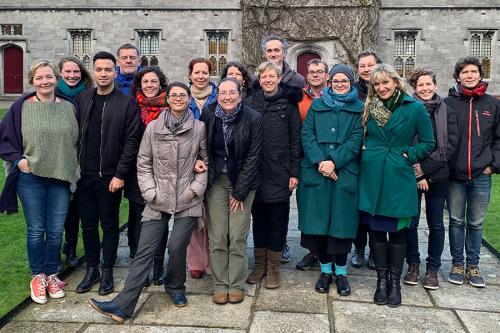
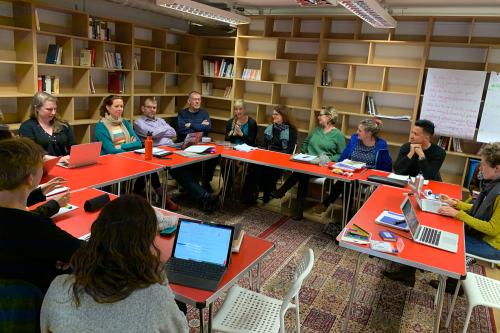
SMiLE research teams and members of the advisory board, Research Workshop 2, University of Galway, Ireland, November 27, 2018.
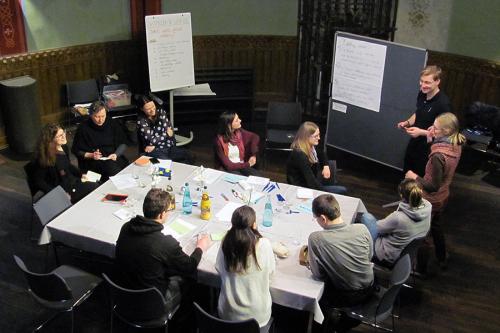
Meeting in Upper Lusatia, Germany, about new communities of practice, Sorbian case study research, Nicole Dołowy-Rybińska and Cordula Ratajczak (upper left).
Outcomes
Overall, the project supported six research teams in eight regions of five countries, asking 75 research questions, for 18 months. Much of the project’s output and impact is available here:
Research Questions – The research questions cover community profile, language ideologies, lifelong learning, policy, and economics. They are useful for academic research and for communities and individuals who want to use them in self-reflection and assessments of their programs.
Case Studies – Seven case studies following the same format answering the research questions above.
Agency in the Peripheries of Language Revitalisation: Examining European Practices on the Ground – Open-access volume generated from the case studies and edited by Mary S. Linn and Alejandro Dayán-Fernández.
Folklife Magazine Stories – Each team wrote a feature article for Folklife Magazine.
Output List – During and immediately after the research period, the principal researchers and their teams produced academic publications, conference talks, theses and dissertations, websites, and media coverage from the SMiLE research. The impressive bibliography of their output through 2020 makes up the Output List.
Impact Report – In 2020, we evaluated the impact of SMiLE research in Critical Understanding, Connecting People & Communities, Creating Educational Opportunities, and Increasing Public Awareness.
Archives – Copies of primary research materials associated with the case studies are housed in Europe at DANS, the Dutch national center of expertise and repository for research data repositories, in the Social Sciences and Humanities data station.
Major Project Events
Collaborative research projects take planning, communication, negotiation, and dedication. Here are some of the steps in developing and implementing the SMiLE research project.
2015
The Center is awarded funding from Ferring Pharmaceuticals to develop case studies on language revitalization in Europe.
2016
In partnership with Grup d’Estudi de Llengües Amenaçades, we host the international workshop Language Vitality in Social Context at the University of Barcelona, October 6–7. Advisory board created. Research questions developed. Call for applications announced, and Linn holds informational meetings at several European conferences. Twenty-three viable proposals received.
2017
The advisory board selects six research teams. The principal researchers in each team are hired as Smithsonian fellows.
2018
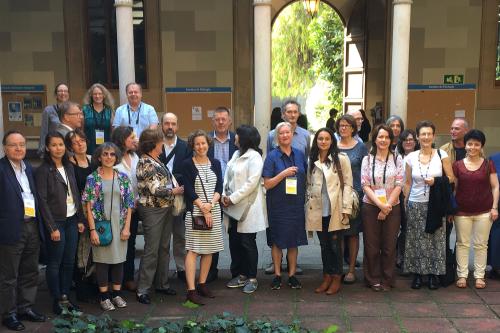
Teams begin research in January with the first Collaboration Workshop at the University of Barcelona.
Second Collaboration Workshop takes place at the National University of Ireland, Galway in November. Linn begins site visits.
2019
Site visits continue. Case studies shared among teams in August. Final collaboration workshop is held at University of Glasgow in October.
2021
SMiLE presents panel “Who saves threatened languages? Examining agency at the periphery of Language Revitalization” at international online conference Conventional and Unconventional Ways of Transmitting and Revitalizing Minoritized Languages in European Context and Beyond, September 8–9.
Proposal for edited book on agency from the SMiLE case studies accepted by Multilingual Matters.
2024
Open-access volume Agency in the Peripheries of Language Revitalisation: Examining European Practices on the Ground, edited by Linn and Dayán-Fernández, is published by Multilingual Matters (London).
Cassie Smith-Christmas discusses findings from the Irish case study, SMiLE Final Collaborative Workshop, Glasgow, Scotland, October 3, 2019.
Case Study Communities
SMiLE research and case studies were completed in summer 2019. Below you can explore the case study communities and research teams. Each profile is in both English and the focus language(s) or variations. The following information is included in each language profile.
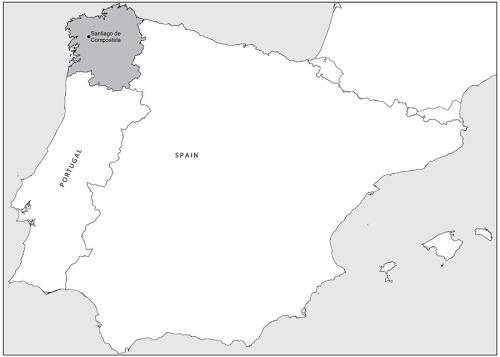
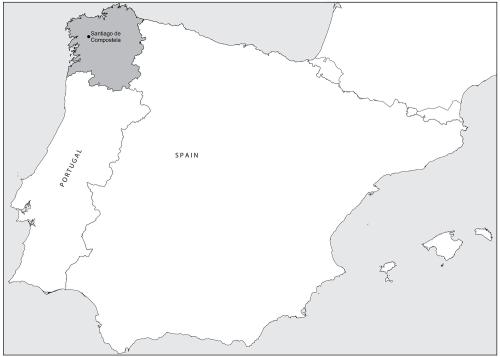
- Santiago de Compostela, location of Semente, GaliciaMap by Dan Cole, Smithsonian Institution
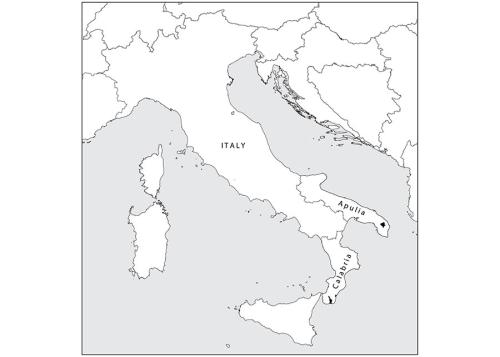
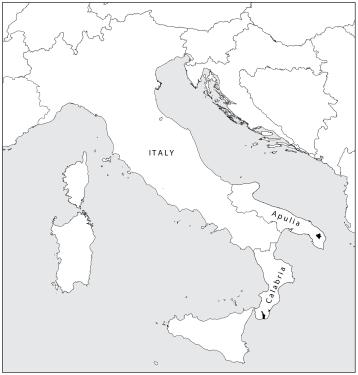
- Griko (Apulia) and Greko (Calabria) language areas, ItalyMap by Dan Cole, Smithsonian Institution
- Greko
- Endonym: to greko, i glossa greka, ta chorìa greka, i Area Grekanika
- ISO Code: none (considered a dialect of Greek: gre)
- Current Speakers: unknown
- Griko
- Endonym: 'o griko, i glossa grika, ta chorìa grika, i Grecìa Salentina
- ISO Code: none (considered a dialect of Greek: gre)
- Current Speakers: unknown
Greko and Griko are the two minoritized languages of Greek origins spoken in the south of Italy.
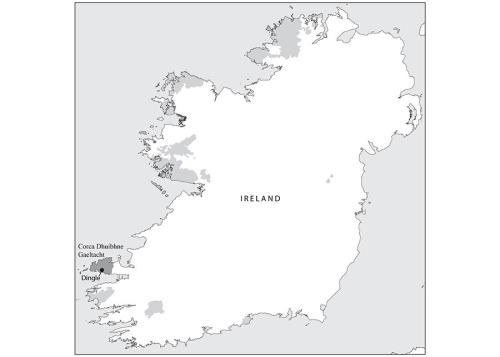
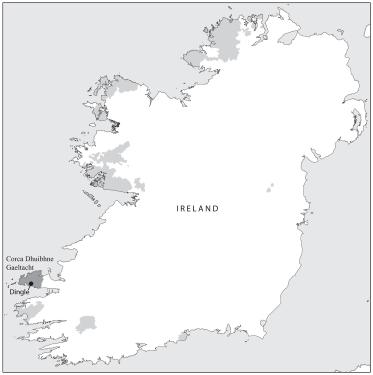
- Corca Dhuibhne Gaeltacht, County Kerry, and the other Gaeltacht districts, IrelandMap by Dan Cole, Smithsonian Institution
- Endonym: Gaeilge (variants: Gaelainn, Gaoluinn)
- ISO Code: gle
- Current Speakers: <80,000
Irish is one of the six Celtic languages. Although it is Ireland’s primary official language, the number of daily speakers outside the education system is estimated at less than 80,000. This reality stems from centuries of language shift, the underlying causes of which share similarities with other minority language communities worldwide.
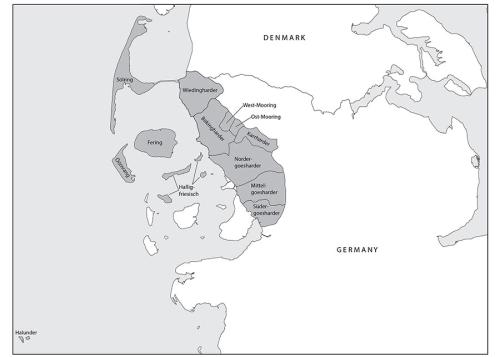
sharder, Mittelgoesharder, Sudergoesharder.
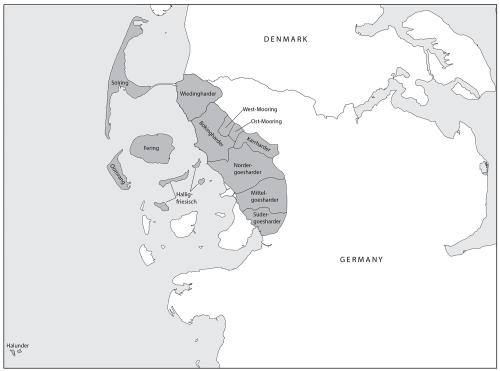
sharder, Mittelgoesharder, Sudergoesharder.
- Nordfriesland with North Frisian dialect areas, Schleswig-Holstein, GermanyMap by Dan Cole, Smithsonian Institution
- Endonym: Friisk (variants: Frasch, Fräisk, Fräisch, Freesk, Fering, Sölring, Halunder, Öömrang)
- ISO Code: frr
- Current Speakers: 5,000–7,000
North Frisian is an endangered West Germanic language spoken along the coastline and islands of the far northwest of Germany. The language is traditionally divided into two main groups—Island- and Mainland North Frisian—due to the different arrival times of Frisians to their current homeland.
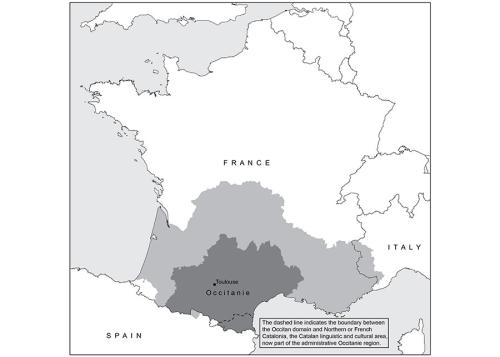
southern tip of Occitanie is separated by a dashed line. Text: The dashed line indicates the boundary between the Occitan domain and Northern or French Catalonia, the Catalan linguistic and cultural area, now part of the administrative Occitanie region.
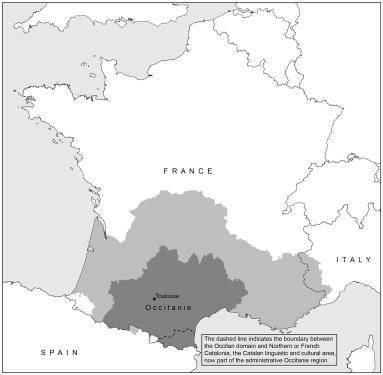
southern tip of Occitanie is separated by a dashed line. Text: The dashed line indicates the boundary between the Occitan domain and Northern or French Catalonia, the Catalan linguistic and cultural area, now part of the administrative Occitanie region.
- The French administrative region of Occitanie (dark gray) situated within the Occitan linguistic and cultural domain (light gray)Map by Dan Cole, Smithsonian Institution
- Endonym: Los occitans
- ISO Code: oci
- Current Speakers: 600,000–3,000,000
Occitan is a Romance language spoken in Southern France and parts of Italy, Catalonia, and Monaco. The Occitan context in Southern France represents one of the earliest cases of language revitalization in Europe, with ongoing literary and language movements since the sixteenth century.
southern tip of Occitanie is separated by a dashed line. Text: The dashed line indicates the boundary between the Occitan domain and Northern or French Catalonia, the Catalan linguistic and cultural area, now part of the administrative Occitanie region.
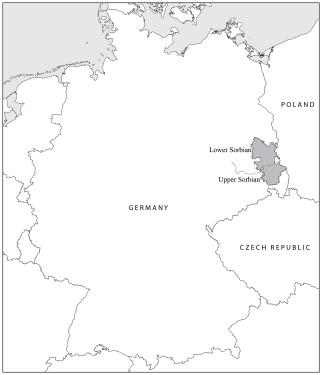
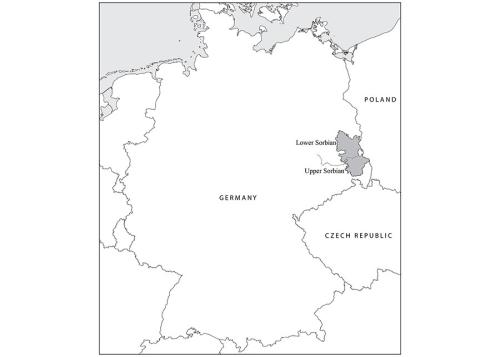
- Official bilingual Sorbian-German areas in Lower Lusatia (Brandenburg) and Upper Lusatia (Saxony), GermanyMap by Dan Cole, Smithsonian Institution
- Upper Sorbian
- Endonym: Serbja
- ISO Code: hsb
- Current Speakers: 15,000
- Lower Sorbian
- Endonym: Serby
- ISO Code: dsb
- Current Speakers: <4,000
The smallest Slavic group with approximately 60,000 members, the Sorbs are an autochthonous minority inhabiting Lusatia, Germany. They are divided ethnically and linguistically into Upper Sorbs and Lower Sorbs. Both languages have a long written tradition.