

Connecting to the Landscape
Through the SomVallBas project, we feature stories about place. These narratives illustrate how landscape soaks into personal identity.
In the Vall d’en Bas, the landscape is remarkably present. It is in the trails, waterfalls, beech groves, creeks, gorges, pastures, fields, hollows, mountain slopes, and peaks. As in most places, human activity responds to the environment with traditions like mushroom hunting, landscape painting, carving boxwood spoons, cultivating local varieties of peppers, horseback riding, hiking, fishing, bicycling, and hunting. Quite naturally, the community is steeped in this neck of the woods.
For locals, “this neck of the woods” isn’t the Vall d’en Bas, but rather one of the eight towns it encompasses. Within these towns, many residents identify with the specific farmhouses that bear traditional names and are in precise places: under the shadow of the Puigsacalm, or behind the Gurn creek, for example. It’s a system so ingrained that locals often do not recognize family names, only house names. A woman might be known as Maria de Cal Flequer, or Mary of the Baker’s Nook. Through the farmhouses, locals connect to landscape.
Gallery




1 / 6
From the Serra of Llancers, we can see the geographical unity of the Vall d’en Bas: the mosaic of fields and villages framed by mountain ranges, cliffs, and the snowy Pyrenees in the background. This plain, watered by a multitude of streams and rivers, is one of the most fertile in Catalonia.
Photo by Marc Planagumà
2 / 6
Although surrounded by mountain ranges, from Can Riera of Joanetes, the valley is wide and open. In the Vall d’en Bas, everything is part of the landscape: fields, farms, streams, chestnut trees, oaks, beeches, and greenish mountains in the background.
Photo by Meritxell Martín i Pardo
3 / 6
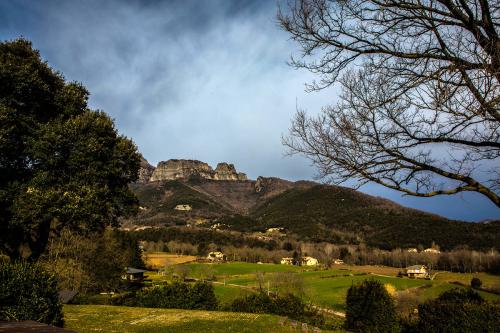
The Puigsacalm-Bellmunt range is the backdrop for Mas les Comelles of Joanetes. Elderly people of the Vall d’en Bas say that before the fields and the forests and cliffs, there were meadows. These were filled by rabbits and partridges, and many flowers that fed the bees.
Photo by Marc Planagumà
4 / 6
A mere twenty-minute stroll from downtown St. Privat, there is a pine forest known as the Pins, or “the Pines,” which has been set up as a picnic area with tables and barbecues. The Gurn River Gorges have served as natural pools where locals have learned to swim for many years.
Photo by Meritxell Martín i Pardo
5 / 6
Situated at the foot of Puig (“Little Mount”), El Mallol is a walled town with a castle destroyed in the earthquakes of 1428. Like so many other homes, La Carrera seeks shelter from the fog and the cold winter on slopes and flanks of hills and mountain ranges.
Photo by Meritxell Martín i Pardo
6 / 6
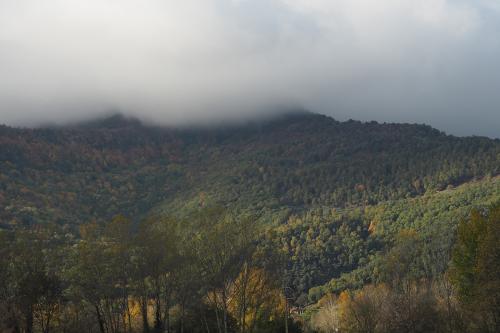
The Rovira and Tossa de Pujolriu forest is covered by an accumulation of clouds and fog, a meteorological phenomenon along the Llancers Range that locals call the “Bar of the West.”
Photo courtesy of Clara Soler
The home anchors its members to place. Likewise, houses and in some cases neighborhoods are known for specific commodities, such as produce from the garden, mushroom preserves, or boxwood ornaments. These products are not branded as “local” but rather “hyperlocal.” They originate not just from the Vall d’en Bas (the municipality), or from Joanetes (the town within the municipality), but from Rose’s of Cabin’s Pad (the house within the town within the municipality)! So, in the Vall d’en Bas, local is hyperlocalized.
We could also say the home fastens its members to the community. So when a member of a house commits to supporting St. Nick’s Fair (Fira de Sant Nicolau), there is a lot at stake. The behavior of one individual does not reflect on solely on them, but also on the house and the larger community. The home provides its members a heightened sense of accountability, adding to the sense of belonging.
In many ways, in the Vall d’en Bas, the landscape is self, home, and community.
Support the Folklife Festival, Smithsonian Folkways Recordings, Cultural Vitality Program, educational outreach, and more.