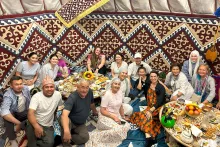
Artists Karina Ramirez and Abel Aguilar, along with family members and team members from the Benito Juarez Autonomous University of Oaxaca, CIIDIR Oaxaca unit of the National Polytechnic Institute, and the Center for Folklife and Cultural Heritage pose at the 2024 Smithsonian Folklife Festival.
Photo by Fernando Gumeta-Gómez
Art as Cultural Preservation: Showcasing Zapotec Culture at the Smithsonian Folklife Festival
This article is part of a series that supports the Heritage & Handicrafts: OAXACA project, a community-based project that aims to deepen connections between cultural heritage handicraft entrepreneurs in Mexico and markets for their goods.
For Zapotec artisans Karina Citlalli Ramírez and Abel Aguilar, art is the quintessential factor in preserving culture. Both hailing from the village of Zaachila in Oaxaca, Mexico, they represent the cultural ecosystem of the ancestral Dance of the Feather, or Danza de la Pluma. According to two widely accepted origin stories, the dance commemorates the conquest of the peoples of Mexico by the Spanish, or the struggle between the Zapotec and Mixtec peoples of the Central Valleys, dating back more than 500 years.
As a feather headdress and accessory maker, Ramírez alters our understanding of historical objects by presenting us with new ways to revitalize them for everyday use. Similarly, through innovative plaster relief artworks, Aguilar serves as a cornerstone for artisans to preserve their pre-Hispanic cultural roots through education and awareness. Their works stand out not only in their beauty but also create a more complete understanding of the Zapotec world and encourage us to value Indigenous traditions despite modernity.
In 2024, both artisans participated in the Smithsonian Folklife Festival, the institution’s annual showcase of living traditions on the National Mall in Washington, D.C. That year, the program Indigenous Voices of the Americas celebrated the twentieth anniversary of the National Museum of the American Indian in D.C., gathering Native artists and experts from across the hemisphere. Ramírez and Aguilar’s participation is a recognition of the artists who keep alive the rich and extraordinary patterns of Indigenous culture.
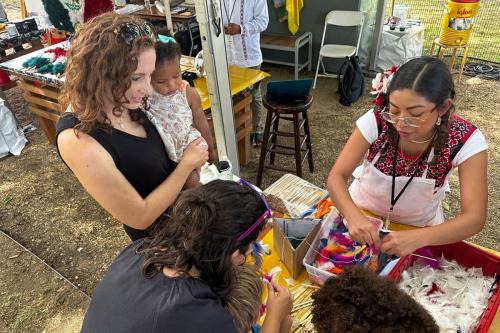
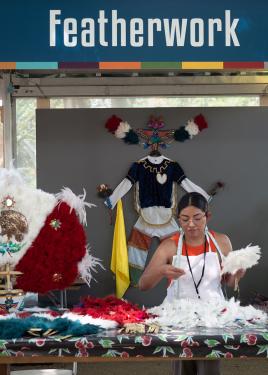
Karina Ramírez teaches youth and adult visitors how to make feather flowers at the 2024 Festival.
Feather Artist Karina Ramírez
Through her work creating feather crowns for the Feather Dance, Ramírez clearly demonstrates her Zapotec heritage and talent for innovation.
“Each of the pieces I create is based on my traditional knowledge of the Feather Dance combined with plastic art,” she explains. “In addition to making the headdresses and headpieces, I make smaller pieces inspired by the nature that surrounds me, which focus on a more practical, everyday use.”
Ramírez is part of the Buidoo Xtera Duub (“spirituality of the feather” in Zapotec) feather art workshop in Oaxaca, and she learns from and works with master dancer and feather artist Iván Cruz. Cruz’s workshop, renowned for its crowns and feather wrapping techniques, is a learning center for young people in the community interested in the dance.
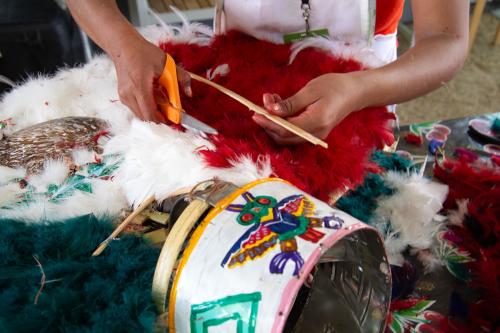
Today, the Feather Dance endures as a living example of Zapotec culture: a tradition that is transmitted from generation to generation through words and brilliant movement. The crowns that Ramírez makes are not mere decorations but highly venerated symbols of the timeless ceremony. Each vibrant feather crown resembles the emotion and spiritual connection of her ancestors, and its current resignification revives Zapotec philosophy about the stars and local cultivation cycles.
But Ramírez doesn’t stop at making traditional crowns; she also draws inspiration from her surroundings to paint common birds of the Central Valleys of Oaxaca on separate feathers, which she sets with precious metals to be used as earrings, necklaces, breastplates, headbands, and ear ornaments. The painted feathers are artistic representations of the region’s biodiversity and cultural histories. Ramírez masterfully captures the colors and shapes of endemic bird species with her brush, bringing Oaxaca’s natural heritage to life.
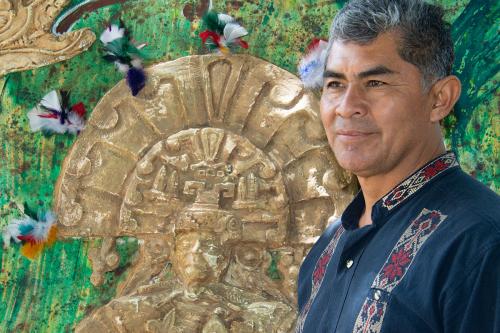
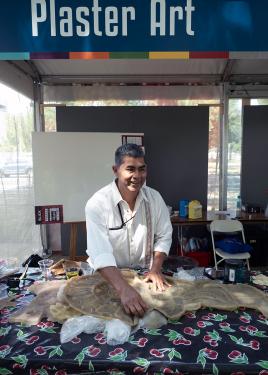
Throughout the week of the 2024 Festival, Abel Aguilar worked on this plaster relief with feather adornments.
Plaster Artist Abel Aguilar
Famous for his stucco relief work that combines pre-Hispanic symbols, shapes, and figures with contemporary materials, Aguilar is strongly influenced by Zaachila, home to an archeological site that contains largely unexplored remains of the pre-Hispanic era.
Using stucco and modern products such as polyurethane, Aguilar replicates symbols, shapes, figures, and other pieces found in the archaeological sites of his community. All the symbols represent parts of the deep Zapotec philosophy, much of which is still maintained in the community’s way of life—because, according to him, they are not just relics of the past but part of the present and future of Zaachila.
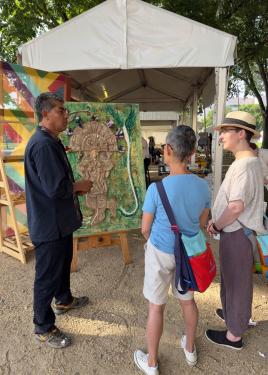
Aguilar explains to Festival visitors the technique and meaning of the background piece he creates through stucco relief.
“It was an honor to participate in the Festival,” he reflected later. “This was a great opportunity for people to see Oaxaca differently and to learn about our Zapotec heritage. I was so happy people wanted to speak with me about my art and culture, so I could share our history and the lessons we can learn from our ancestors.”
Aguilar uses his art to bring the public closer to some of these cultural roots so that they are not lost to locals nor outsiders. By making these teachings available and relevant to younger generations, he hopes that his community will have more respect for Zapotec history and spiritual traditions and find uses for their philosophy in daily life. For him, finding inspiration within the ancestral findings is a way of revitalizing and reclaiming his ancestors, their knowledge, and their history in the face of colonialism and modernity.
Aguilar’s unique materials enable the creation of affordable, handcrafted products tailored to the popular market. These pieces are not only well priced for local citizens and tourists, but they also serve an important function in terms of cultural preservation as Aguilar offers replicas to curb the illegal sale and looting of real archaeological pieces. For this reason, his work is important for the ongoing protection of Zapotec cultural heritage and helps ensure that the Zapotec legacy is respected, celebrated, and used ethically.
Celebrating Indigenous Voices
By including the works of artists like Ramírez and Aguilar in the Folklife Festival, the Smithsonian not only paid homage to their individual contributions but also to the collective contributions of their Zaachila community and the rich cultural diversity of Oaxaca and Mexico as a whole. The voices of the Zapotec community can be found represented in the works of Ramírez and Aguilar who, through their art, celebrate the cultural and natural heritage of their community while igniting the fire that will inspire future generations to value and nurture their legacies.
That summer, the Festival and the National Museum of the American Indian were used in tandem as spaces for engaging with and sharing Native heritage. Together, they enabled the American public to positively connect with Indigenous cultural traditions, expanding their sensitivity, openness, and knowledge by providing context and greater understanding. Within these communities, participants and visitors could celebrate life and reevaluate relationships with other people, other cultures, and the natural environment—all while honoring and respecting the diverse perspectives of Indigenous communities across the Americas.
By participating in the Festival, Ramírez and Aguilar sent a powerful message about art as a key to generating broader conversations between past and present, tradition and innovation. They reminded us that Indigenous cultures and their ways of coexisting in the world are not just relics of a bygone era but realities that are still alive and evolving.
Fernando Gumeta-Gómez is a researcher with the Secretary of Science, Humanities, Technology, and Innovation of Mexico, working at the Interdisciplinary Research Center for Regional Integral Development Oaxaca Unit of the National Polytechnic Institute.
Gustavo Hinojosa-Arango is a researcher with the Secretary of Science, Humanities, Technology, and Innovation of Mexico, working at the Interdisciplinary Research Center for Regional Integral Development Oaxaca Unit of the National Polytechnic Institute.
Folklife Magazine explores how culture shapes our lives. We publish stories about music, food, craft, language, celebrations, activism, and the individuals and communities who sustain these traditions.